

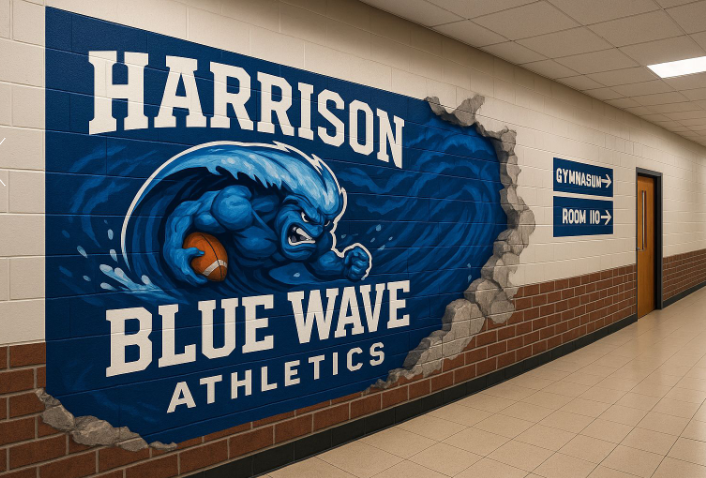
Walk through almost any school gymnasium, dorm stairwell, or field-house corridor built in the last fifty years, and you'll find the same specification: a coat of block filler and a color from the standards list. Not because the architect lacked imagination, but because no graphics product ever existed for that wall. Cinder block has always meant paint. Vinyl won't adhere. Wallpaper isn't an option. So an entire category of surface, and the buildings made from it, went without.
That's the real problem behind wall graphics. Not just an installation inconvenience, but a decades-long material limitation that quietly shaped design decisions. Vinyl graphics work, but they come with built-in compromises: seams and edges, adhesive that fails over time, surface prep, and installation logistics that only get harder as the graphic gets bigger. And because cost and complexity scale with area, design intent has largely been confined to a single accent wall.
East Coast MuralPros solves this by removing the substrate entirely. Their direct-to-wall printing applies high-resolution graphics straight onto the building surface whether it's drywall, brick, concrete, and critically, cinder block, with a mobile printer that eliminates the vinyl sheet, the adhesive, and every failure point that comes with them.
No Substrate, No Compromise
For roughly 80% of the square footage currently specified as vinyl, printing directly on the wall is simply the cleaner answer. There's no panel to seam, no edge to lift, no adhesive to fail years down the line. The printer applies ink directly to the finished surface, which means the graphic is the wall, not something applied to it. For architects specifying high-traffic corridors or graphics with long service-life expectations, removing the substrate removes the maintenance conversation entirely.
Enhancing the Surfaces Buildings Are Actually Made Of
This is the story worth specifying around: cinder block, brick, and raw concrete have never been viable graphic surfaces. This is not by design choice, but by material limitation. Direct-to-wall printing works at architectural scale, on the surfaces gyms, stairwells, and campus corridors are actually built from. Design intent no longer has to stop at the accent wall; it can extend across an entire corridor or field house, at a cost that's competitive with traditional graphics from the first project and increasingly efficient at scale.
Installation is fast enough to respect a working building: most jobs are measured in hours, often under three, so a school or office doesn't need to shut down for it. And because the finished surface uses water-based inks, it's durable and cleanable in the environments that need it most.
A Cleaner Sustainability Story
Every vinyl graphic is a PVC sheet that gets manufactured, shipped, adhered, and eventually landfilled. Direct-to-wall printing doesn't offset that footprint. It removes it. There's no substrate to produce or dispose of, the inks are water-based, and when a graphic's useful life is over, removal is a coat of paint. For firms with material health or embodied carbon commitments, eliminating a material category altogether is a simpler, more defensible story than sourcing a "better" version of the same product. It's also a practical one for specifiers: reversibility. A coat of paint means it's a graphic, not a renovation.
Discover East Coast MuralPros on Acelab's Material Hub
Acelab exists to connect architects with products that solve problems the market hasn't caught up to yet, and East Coast MuralPros is a clear example. Architects don't typically search for a solution to the cinder-block problem, because until now, no alternative existed. That's exactly the kind of product Material Hub is built to surface.
Explore East Coast MuralPros on Acelab's Material Hub to see full project examples and connect directly with the manufacturer to discuss your next corridor, gymnasium, or campus building.
.png)