


The timing problem nobody budgets for
of specifications lock before a manufacturer's rep ever makes contact.
That single number explains why so many building product manufacturers feel busy, well-equipped and still under-specified.
Most BPM sales and marketing stacks were assembled for a different moment in the project lifecycle. Lead databases surface projects when the plan room opens. Spec tools live on someone else's website. Reporting counts impressions and downloads. Each tool does what it was built to do, and none of them reach the design team while basis of design is still an open question.
The result is a growth ceiling that looks like a sales problem but is really a software problem. Reps chase substitutions after bid instead of shaping the spec. Marketing defends budgets with metrics that never connect to a specification. And leadership has no clear view of where share is being won or lost.
As manufacturers plan for 2027, the question is no longer whether to invest in sales and marketing technology. It is whether the stack you already pay for is aimed at the moment specs are actually decided.
Problem one: lead databases find the project after the spec is written
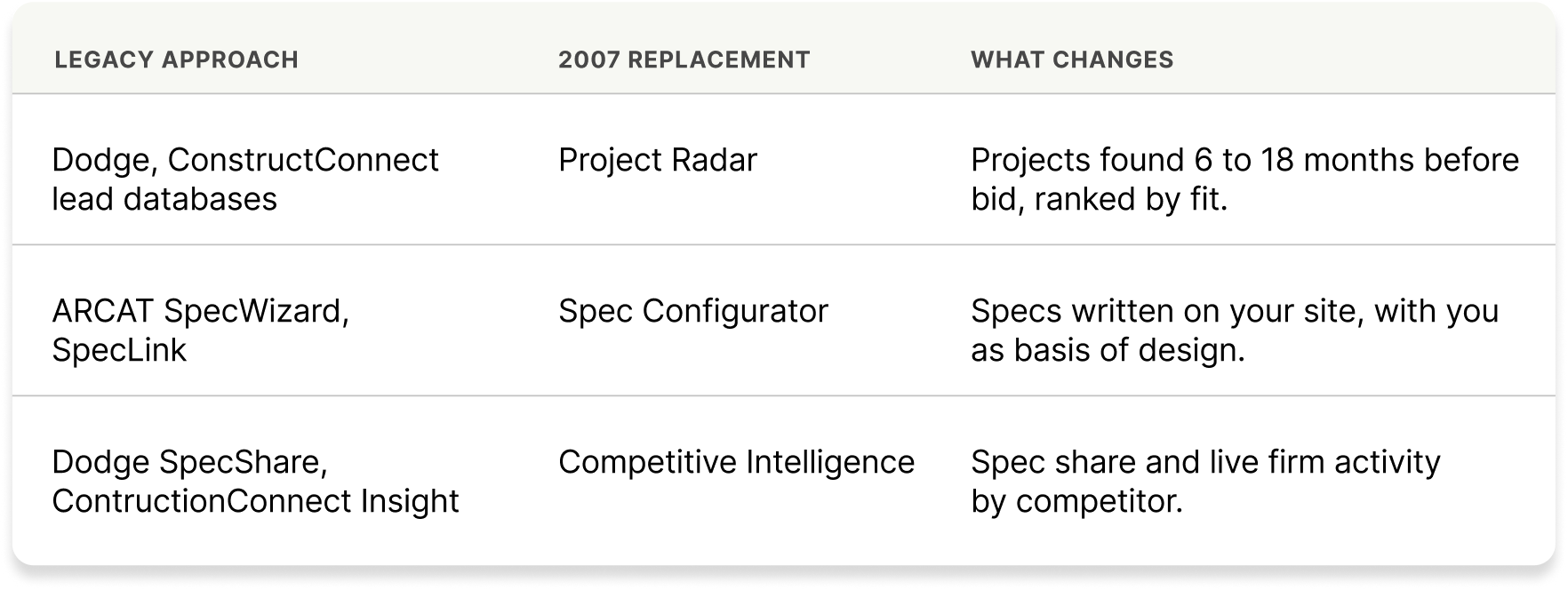
Dodge and ConstructConnect searches mix a 2006 permit with last week's, tag nearly everything "commercial new construction," and often need a Boolean string only one person can write. Worse, reps usually find the project when the plan room opens, after the spec is written.
Manufacturers need design-stage visibility instead: projects and the firms on them 6 to 18 months before bid, ranked by fit, with the reason on every row.
Problem two: your spec tool sends specifiers off your website
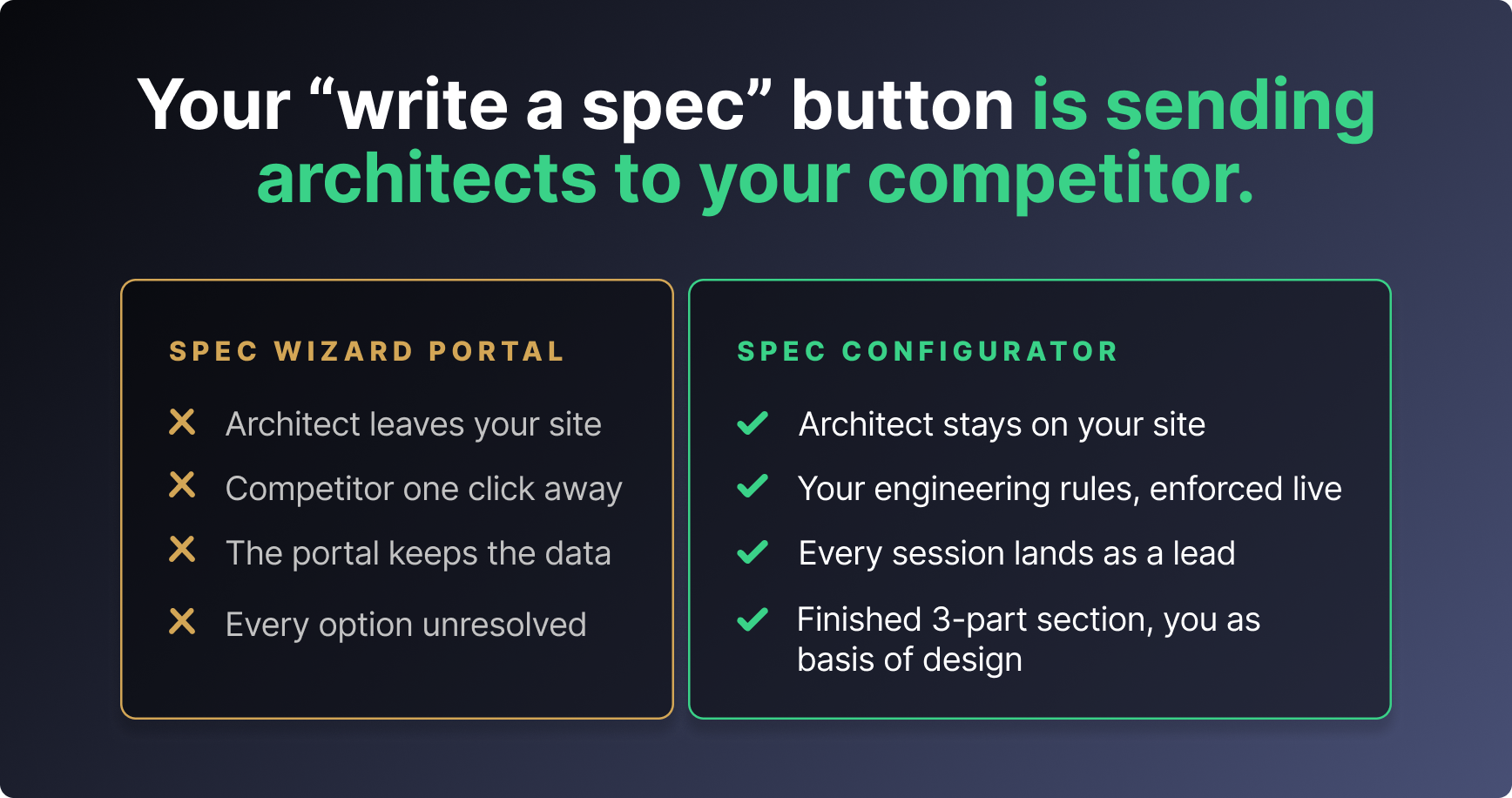
When a specifier clicks "write a spec" on your product page, tools like ARCAT SpecWizard and SpecLink redirect them to a third-party portal. Your competitor is one click away, the user data stays with the portal, and the output lists every option instead of resolving them, so errors surface at submittal. Manufacturers pay roughly $5K per subscription for this.
The better model keeps the specifier on your site, with your engineering rules enforced as they work.
Problem three: reporting that can't be explained to the CFO
Impressions, downloads and "engaged accounts" don't map to a specification, and tools like Dodge SpecShare and ConstructConnect Insight rarely produce a number finance will accept. Meanwhile, many manufacturers first learn a competitor became a firm standard when their product is missing from the drawings.
Useful reporting answers three questions: where you're winning or losing spec share, where your content falls short, and which firms are researching your category now.
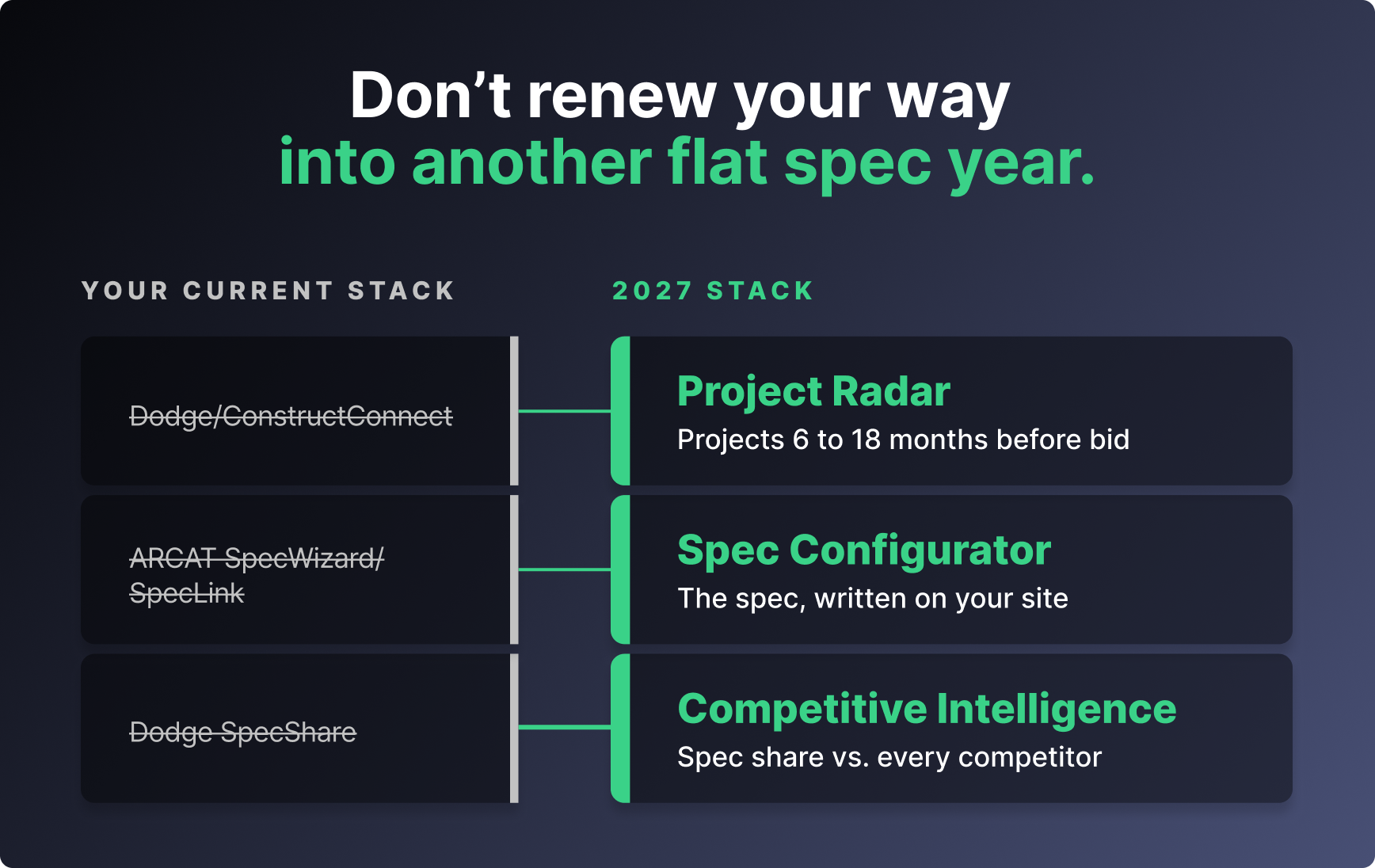
What a 2027 specification growth stack looks like
AI now makes it possible to replace each of these legacy tools with one built for the design stage. At Acelab, we have built three releases around that idea, each connected to Material Hub and its activity data from 20,000+ AEC firms.
Project Radar: design-stage project intelligence
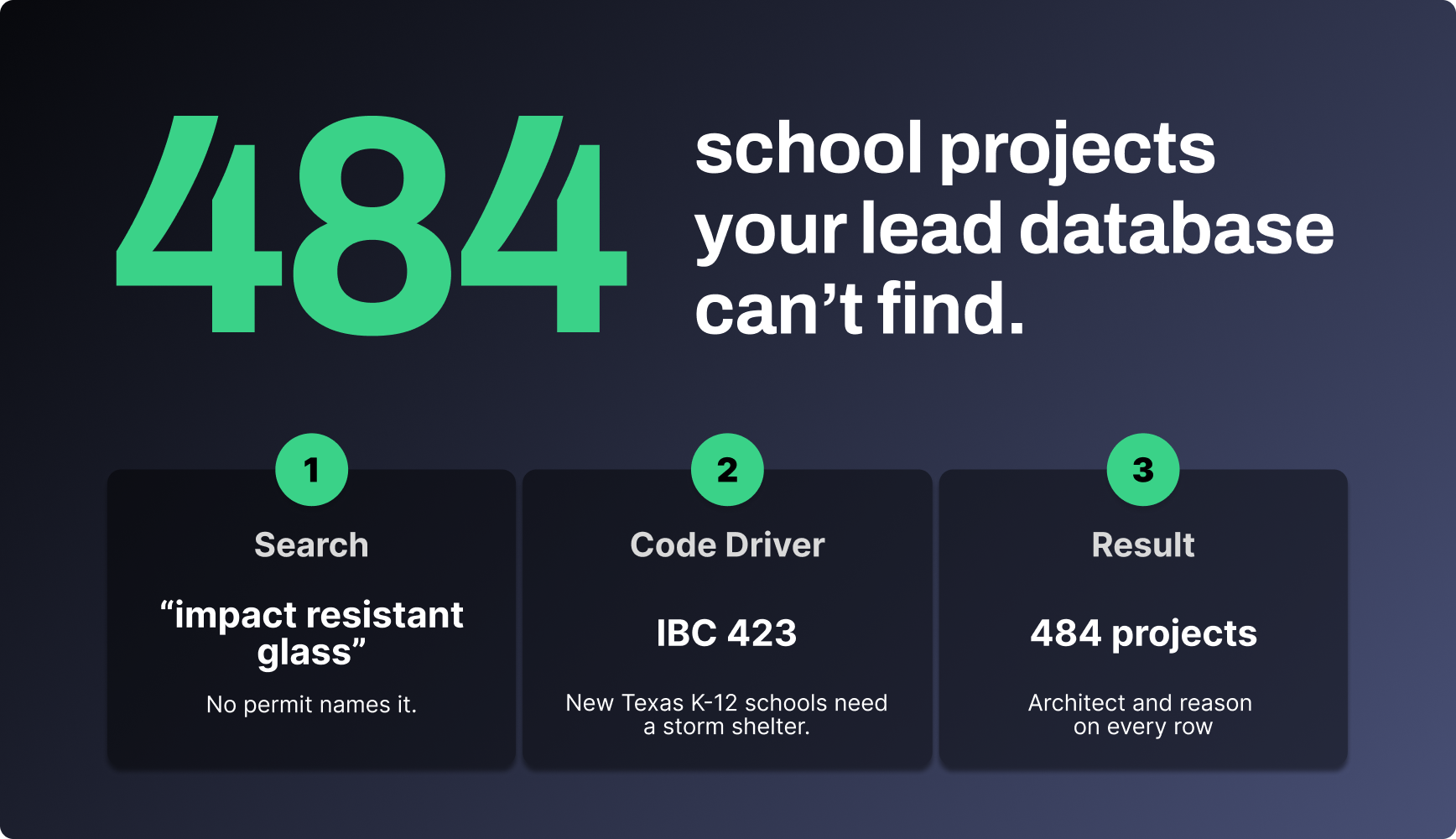
Project Radar reasons about need, not just keywords. Search "impact resistant glass" and no permit will name it. Project Radar works from code instead: new Texas schools must include a storm shelter under IBC 423, which points to 484 new K-12 projects that will need the product, with the driver listed on each one.
Saved searches report what is new since you last ran them. Because it connects to Material Hub, Project Radar can also show whether a firm has researched your category in the last 90 days, a signal no plan-room product can produce.
Spec Configurator: your website becomes the spec tool
The specifier never leaves your site. The output is a finished 3-part CSI section or submittal package with your product as basis of design. Hard conflicts, such as a track size that voids a warranty or an operator that fails code, are blocked before the spec ships.
Every session lands in Manufacturer Hub as a lead, with the project and configuration attached. Typical scope runs $25K to $40K a year for a full product line.
Competitive Intelligence: spec share you can defend
Competitive Intelligence puts three reports on one page:
Market: platform spec share and firm-standard count against each competitor, by vertical, over the trailing twelve months.
Product: which lines specifiers search for, where content is missing, and search-to-spec conversion against the category benchmark. One example: a healthcare LVT searched 980 times, with infection-control specs not indexed.
Sales: live firm activity by project, addressable pipeline by competitor, and win rate against each. One example: a Gensler team evaluating a competitor for a $38M headquarters renovation, with the manufacturer's product not in the set.
Marketing gets a number it can defend. Sales gets a list it can call.
Five questions to ask of your current stack
Before 2027 budgets are set, sales and marketing leaders can pressure-test their tools with a few direct questions:
- When do our reps typically first hear about a project: during design, or when the plan room opens?
- Can anyone besides one power user build a useful search in our lead database?
- When a specifier clicks "write a spec" on our site, where do they end up, and who keeps the data?
- Does our spec tool resolve configuration decisions, or does it leave them for submittal?
- Can we state our spec share against our top three competitors in a single number?
If the answers are uncomfortable, the gap is not effort or headcount. It is a stack aimed at the wrong moment.
See the stack in action
We are walking through all three releases in a recurring webinar for building product manufacturers: BPM Specification Growth Stack 2027: three AI tools replacing the sales and marketing software that's capping how often you get specified.
It is built for sales, marketing and leadership teams at manufacturers of every size, from SMB to enterprise.
Register for the next session: