


Collaboration is what holds a specification. Everything else is a product pitch.
Every platform selling to building product manufacturers makes the same promise: more leads and better targeting. The logic is that if you get in front of enough architects, specifications follow.
That is not usually the case. Most leads arrive after the product decision has already been made, when the architect is confirming a selection rather than making one. A lead at that stage is a bid invitation, not an opening.
A lead is a name and a moment of interest. It tells you someone looked. It does not tell you whether that person will take your rep's call, whether they trust your technical answers, or whether your product becomes the one they reach for on the next project without thinking about it.
The manufacturers who win specifications consistently are not necessarily the ones with the longest lead lists. They are the ones whose reps architects call first, because those reps have become advisors to the project.
They bring the technical answer at the moment the design team is stuck. They respond the same day. They know the project well enough to add something the architect did not think to ask.
That is a different job from pushing products. And it is the job that gets you specified.
How architects actually decide what products to specify
Ask an architect why a product ended up in the spec, and you will rarely hear about a campaign. You will hear about a person.
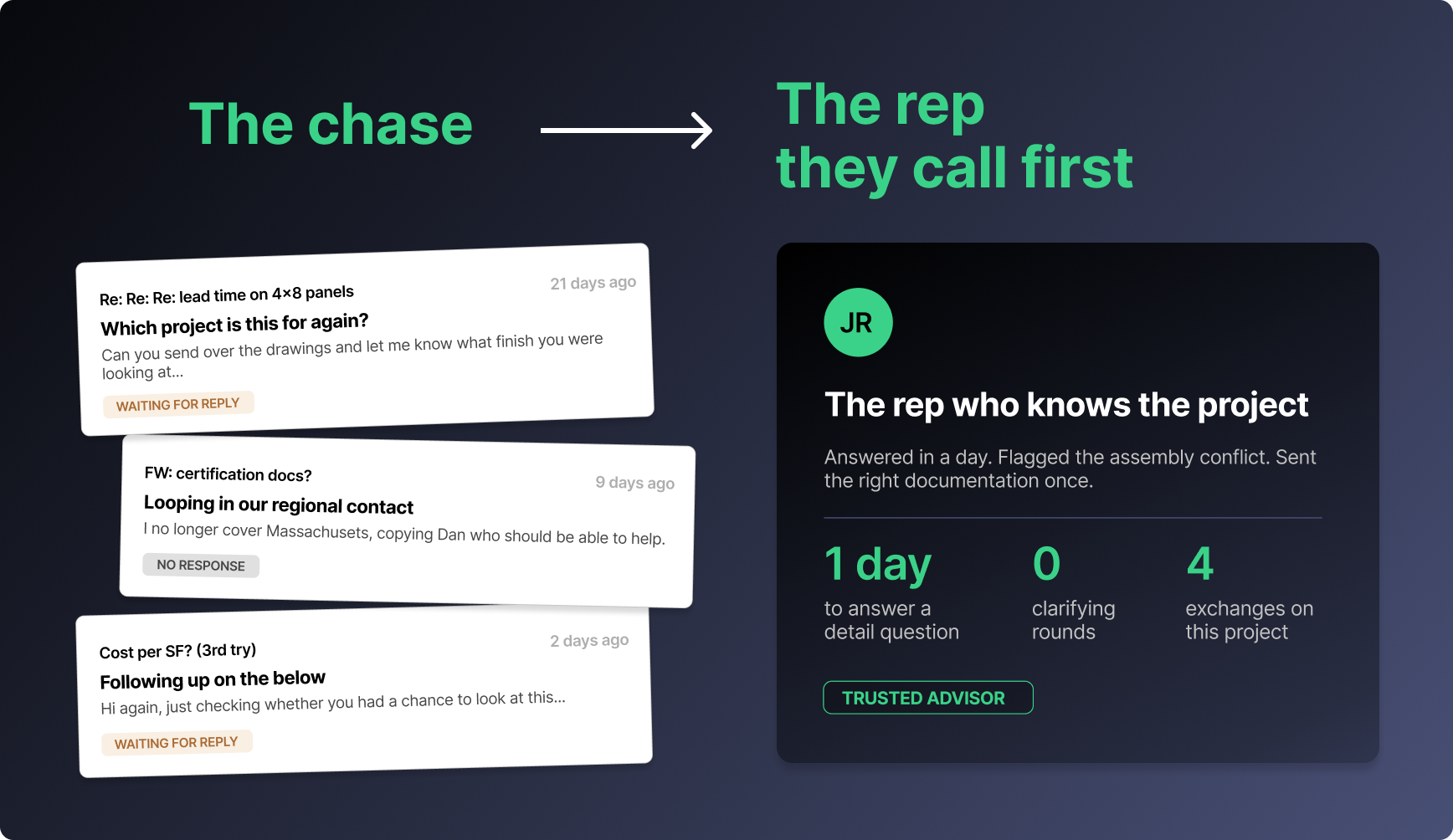
The rep who answered a detail question in a day instead of three weeks. The rep who knew enough about the project to flag an assembly conflict before it became a redesign. The rep who sent the right documentation the first time, in the format the team needed.
That is what a trusted advisor looks like in this industry. It isn't unglamorous, and it is earned in small exchanges, one project at a time.
Most reps answer into the dark. The ones architects call first know the project.
The problem is that most reps have no way to be that person at scale. They get a lead with no project attached. They field a question by email with no visibility into what the architect already has or what stage the decision has reached. They answer into the dark, and they rarely learn what happened next.
You cannot build trust from that position. You can only guess at it.
What if you became a member of the project instead of a vendor to it?
Product selection starts long before the specification is written.
It begins in schematic design, when the architect is comparing assemblies, testing details, and deciding what the building is going to be made of. The specification at the end records those choices.
Engage at that point, and something different happens.
Your rep is in the conversation while the choice is still being made. They are answering questions about thermal performance at the parapet, lead times and their impact on the schedule, or whether a particular assembly will work before anyone has committed to a preferred option.
The architect is no longer evaluating your product against a competitor. They are working through the problem with you.
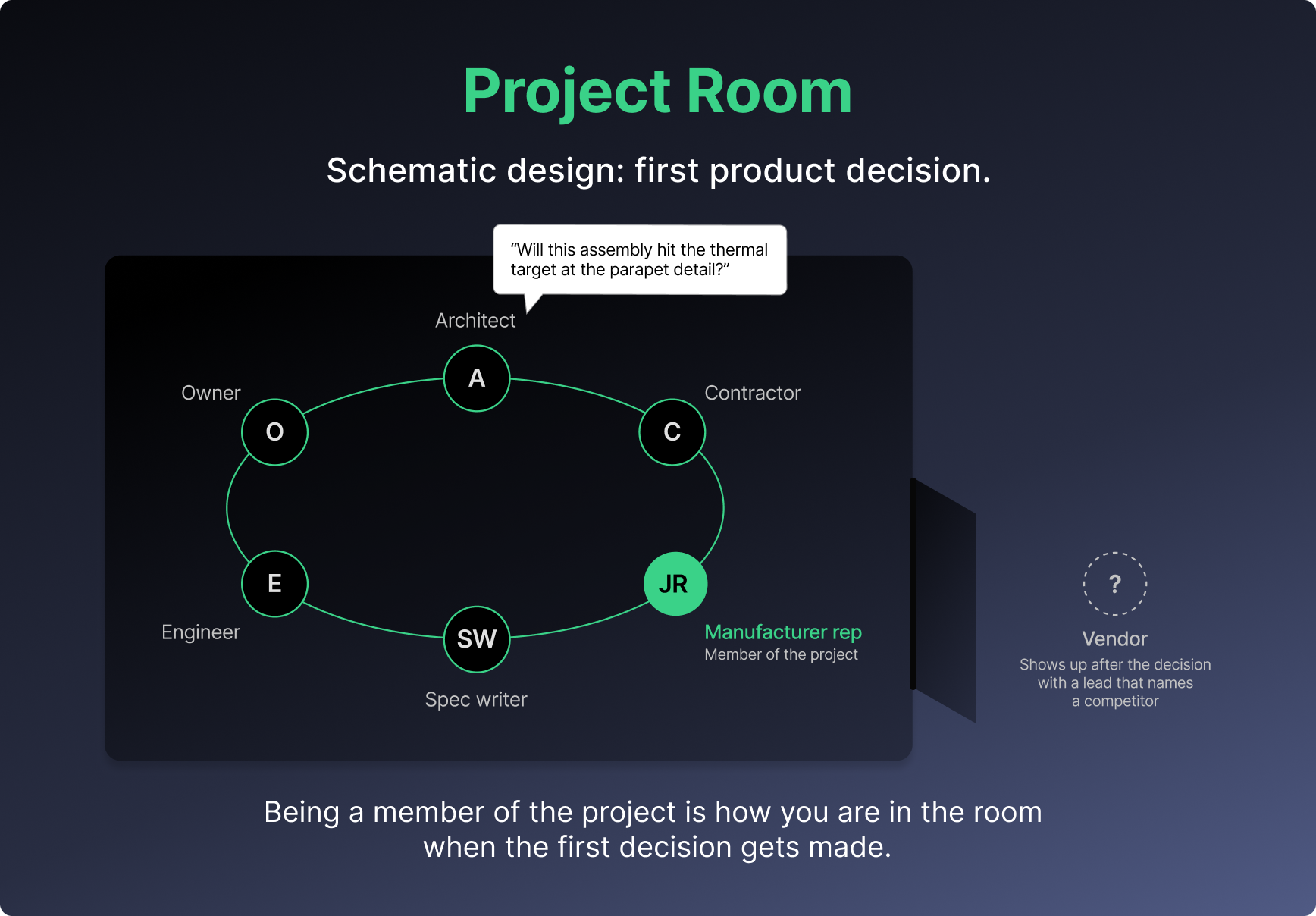
Schematic design. The rep in the room is part of the selection, not a confirmation of it.
That changes what you are to the project. You go from someone who supplies a product to someone who helps decide what product the project needs.
The assembly gets drawn around something that fits. The choice carries your fingerprints.
A specification that comes out of that process holds. When it is finally written, it names a product the team already trusts, backed by a rep they already rely on.
Being a member of the project is how you are there when the selection is made, not when it is confirmed.
Tech-enabled collaboration for building product manufacturers
None of that scales on goodwill alone.
A rep covering forty firms cannot be a project participant on all of them by force of personality. To make those relationships work at scale, collaboration has to be built into the tools both sides already use.
Automated RFI in Material Hub is designed for exactly that.
When an architect needs cost, lead time, or certification data, they select your product and the specific fields they need. Material Hub sends a numbered inquiry straight to your rep.
Your rep opens it and gets the full project context: the project type and size, its location, the budget, the products under consideration, and the specific information being requested.
That context changes the conversation. Instead of a vendor writing back to ask, “Which job is this for?”, the rep can immediately answer the question the architect actually needs answered.
Follow-up questions happen inside Material Hub, in the same thread, so nothing moves to an email chain the architect has to chase. If an inquiry sits unanswered, the rep gets a reminder, so a relationship does not go cold simply because a message got buried.
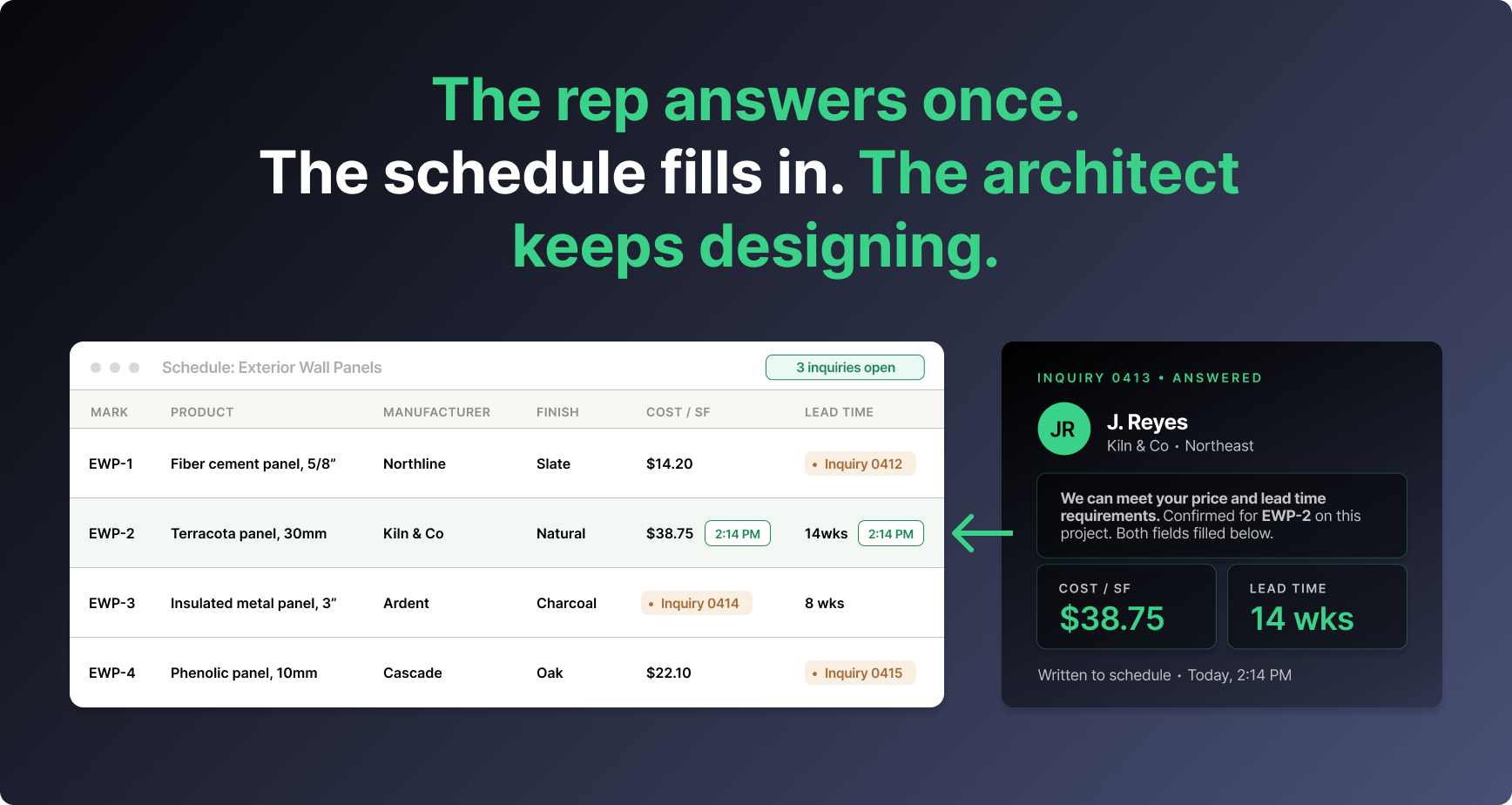
The rep confirms price and lead time once. Both fields write into the architect's schedule, time-stamped.
The answer writes directly into the architect's schedule, marked and time-stamped. The architect keeps designing.
Your rep has just been useful at the exact moment when usefulness was worth something, and there is a record of that interaction that both sides can see.
That is fundamentally different from a lead notification.
A lead tells your rep that someone is interested. An Automated RFI tells your rep exactly what the project needs and gives them a way to deliver it the same day.
Do that four times across one project, and the relationship has changed. Your rep is no longer simply being evaluated as a product resource. They become the person the team checks with before making a decision.
Relationships you can see
There is another thing missing from lead-based platforms: memory.
A lead arrives, gets worked, and disappears into a CRM record that says nothing about the health of the relationship behind it.
The Architect Engagement Portal tracks the relationship instead of just the transaction.
Which firms are engaging with your products, and at what stage? How many projects are they engaging on? Which of your products have moved into a firm's library as a standard? Which RFIs are active, who asked the question, what information was requested, and whether your rep has answered?
You can also see where an exchange is moving forward and where one has gone quiet.
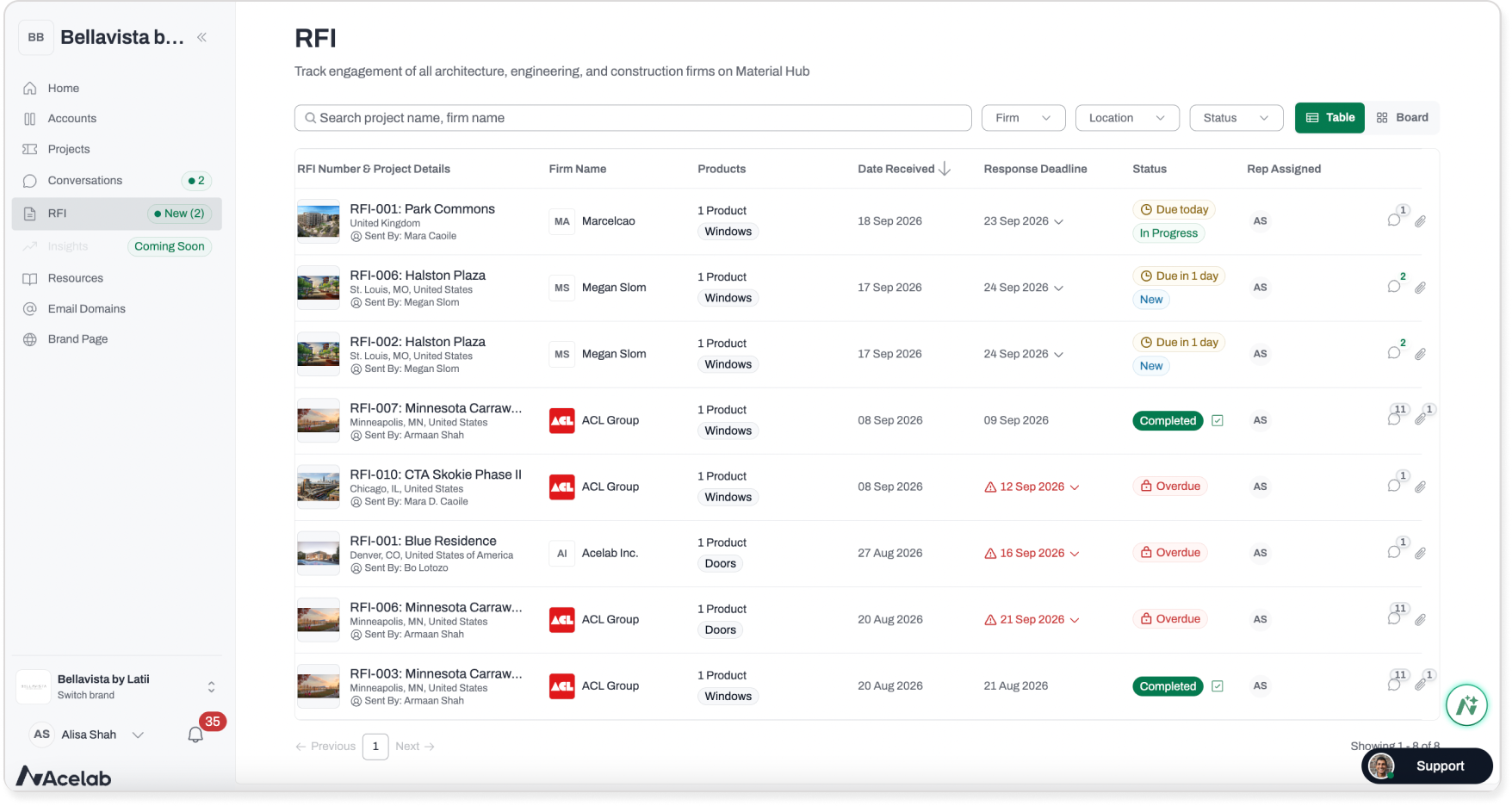
The manufacturer view in Material Hub: every active RFI by firm and project, with deadline, status, and the rep assigned.
That gives your sales leadership something a lead count cannot: a view of which architect relationships are deepening and which need attention.
It also gives a new rep a running start on an account instead of a cold introduction. They can see the history of the relationship, the projects involved, and the conversations that have already happened.
That is what turns individual interactions into an account strategy.
What stronger architect relationships build
A specification is the visible result. The asset underneath it is the relationship that produced it.
And that relationship pays out across every project that firm designs for years to come.
The manufacturers doing this well can become the basis of design and, eventually, the firm standard. Not because they bought better placement, but because their reps became the people architects trust with a hard question on a Friday afternoon.
Cold leads are easy to sell and easy to buy. Collaborating with an architect on a live project is harder, slower, and worth considerably more.
That is the shift: stop treating the architect as a lead to be converted and start treating them as a project partner to be supported.
The manufacturers that build those relationships are not waiting for the specification to arrive. They are helping shape the decision before the specification is written.
If you want to see what your architect relationships look like when you can actually track them, ask us for a walkthrough of Material Hub and our new Automated RFI collaboration tool.